About this database
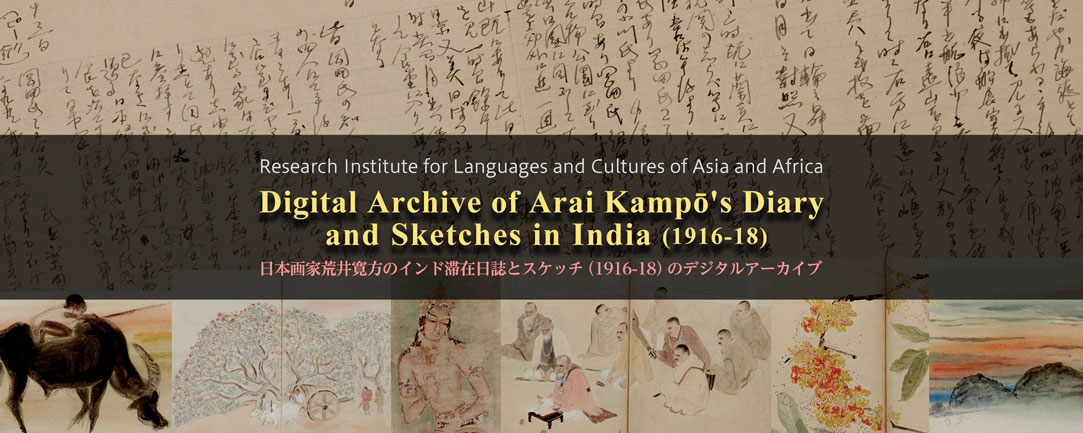
Arai Kampō (1878–1945), a Japanese painter, was invited to India by the poet Rabindranath Tagore at the end of 1916, and stayed at his residence in Calcutta (present-day Kolkata) for approximately a year and a half. While teaching Japanese-style painting (Nihonga) at the newly established Bichitra Studio, he formed close relationships with leading figures of the Neo-Bengal school, including Abanindranath Tagore (1871–1951), Nandalal Bose (1882–1966), and Mukul Chandra Dey (1895–1989). Kampō also traveled extensively across India, documenting its customs, people, nature, and cultural heritage, while producing reproductions of the Ajanta cave murals that had influenced ancient Buddhist art throughout Asia.
This digital archive contains the transcripts of Arai Kampō’s handwritten diaries kept during his stay in India, as well as 870 sketches and related documents. These materials are invaluable for understanding the early formation of Indian national culture through the vibrant artistic network that surrounded the Tagore family, a hub of India’s cultural revival. For Kampō, this experience became a professional turning point that later influenced his involvement in the reproduction of the murals in the Kondō (Golden Hall) of Hōryū-ji Temple in Japan.
Jointly produced by the Kampō-Tagore Association, this archive was established with the cooperation of the Tochigi Prefectural Museum of Fine Arts and the Sakura City Museum (Arai Kampō Memorial Museum). It serves as a digital resource for research, education, and social contribution by presenting both literary and visual materials.
Research Grant
This archive was built under the following research grant:
- 2024 IRC Project:
- “Digital Archiving of Arai Kampo’s Indian Journals and Sketches (1916–18)”
- (Project Leader: Togawa Masahiko) – chief producer of the database
Copyright
The contents of this database are licensed under CC BY-NC-ND 4.0.
Contact
- Contact:
- Togawa Masahiko: fakir[at]aa.tufs.ac.jp
- Kawai Tsutomu (Tom): kampotagore[at]gmail.com
Materials Provided by
- Tochigi Prefectural Museum of Fine Arts
- Sakura City Museum (Arai Kampō Memorial Museum)
Key References
- Nonaka Taizō, Arai Kampō, Chūōkōron bijutsu shuppan, 1974.
- Ajia kindai kaiga no yoake ten (Exhibition of the Dawn of Modern Asian Painting), Mainichi Newspapers, 1985.
- Indo to Arai Kampō: Myūjiam ujiie kaikan 5-shūnen kinen tokubetsu-ten (India and Arai Kampō: The 5th Anniversary Special Exhibition), Museum Ujiie, 1998.
- Indo wo egaita sakka tachi: Tagōru seitan 150-nen kinen (Artists Who Depicted India: The 150th Anniversary of Tagore’s Birth), Sakura City Museum, 2011.
- Inaga Shigemi, Kaiga no rinkai: Kindai higashi ajia bijutsu-shi no sikkoku to meiun (Critical Point of Painting: The Shackles and Fate of Modern East Asian Art History), Nagoya University Press, 2014.
- Azuma Kazuo, Tagōru no sekai (The World of Tagore), Daisan bunmei-sha, 2017.
- Mikami Miwa, Hara Sankei to nihon kindai bijutsu (Hara Sankei and Modern Art of Japan), Kokusho kankōkai, 2017.
- Togawa Masahiko, Okakura Tenshin to indo: “Ajia wa hitotsu” ga umareru made (Okakura Tenshin and India: The Birth of “Asia Is One”), Keio University Press, 2023.
Production Staff
- Production:
- Togawa Masahiko (ILCAA, Tokyo University of Foreign Studies)
- Kawai Tsutomu (Tom) (Secretary General, Kampō-Tagore Association)
- Academic Advisor:
- R Siva Kumar, Professor of History of Art, Kala Bhavana, Visva-Bharati University
- Editorial Supervisor:
- Nilanjan Bandyopadhyay, Special Officer, Rabindra Bhavaana, Visva-Bharati University
- Academic Consultant in Bengali:
- Sudipta Das, Nippon-Bhavana, Visva-Bharati University
- Academic & Editorial Collaborator:
- Okamoto Yoshiko, Institute of Asian Cultural Studies, International Christian University
- With Cooperation from:
- Rabindra-Bhavana, Visva-Bharati University, Santiniketan, India
- Information Resources Center (IRC), ILCAA, TUFS
- TUFS Field Science Commons (TUFiSCo)
- ILCAA Core Project – Anthropology
- Tochigi Prefectural Museum of Fine Arts
- Sakura City Museum (Arai Kampō Memorial Museum)
- Transcription and Proofreading
- Oikawa Akio (Mokuyōsha) (*As of 2024)
- Design
- Horiuchi Color
(Institutional affiliations are as of 2025, when the database was created.)