
About Arai Kampō
Arai Kampō (August 15, 1878 – April 16, 1945) was a modern artist who painted in Japanese-style called Nihonga. He was born Arai Kanjūrō in Ujiie Town (central part of present-day Sakura City), Shioya District, Tochigi Prefecture. He was a member of the Japan Art Institute (Nihon Bijutsu-in) and exhibited his works regularly at the Inten, the Institute’s official exhibitions.
Kampō was born into a family of pictorial decorator who specialized in family crests and lanterns. In 1899, he began his apprenticeship under Mizuno Toshikata, a well-known Ukiyoe and Nihonga artist, from whom he learned the styles of history and genre painting. The following year, he was formally given the art name “Hirokata” by his master. But in practice, he was commonly referred to as “Kampō.” He was considered one of the “big four” among Mizuno’s disciples, alongside Kaburaki Kiyokata, Ikeda Terukata and Ōno Shizukata.
In 1901, Kampō exhibited a work of genre painting entitled Warmth at the joint event of the Tenth Exhibition of the Japan Association for Painting (Nihon Kaiga Kyōkai) and the Fifth Exhibition of the Japan Art Institute. Upon receiving a second-class commendation, he went on to win awards at the same exhibitions. In 1902, he joined Kokka-sha, the publishing company, where he honed his skills by reproducing Buddhist paintings for Kokka, the art magazine.
In 1907, Kampō’s work entitled Under the Bodhi Tree was accepted for the first Bunten, the art exhibition sponsored by the Ministry of Education. He was recognized with multiple awards during the second to fourth Bunten Exhibitions. During that period, he became involved in art groups such as the Tatsumi Art Society and Kōji-kai, and gained support from Hara Sankei, who was a prominent entrepreneur and patron of the arts.
In 1914, Kampō submitted Autumn Dusk (Collection of the Sakura City Museum) to the inaugural Revival Inten (Revived Japan Art Institute Exhibition) and became an associate member. The following year, Offering of Milk Porridge, which depicted Sujata holding a bowl of porridge for the Buddha, enabled Kampō to gain full membership of the Institute alongside Nakamura Gakuryō and Tomita Keisen. Subsequently, Kampō emerged as a pivotal figure in the Inten Exhibitions.
In November 1916, he traveled to India at the invitation of Rabindranath Tagore, the Indian poet who had visited Japan. Kampō was appointed instructor of painting at the Bichitra Studio for Artists of the Neo-Bengal School, established in Tagore’s residence in Calcutta (present-day Kolkata). During his one and a half year stay, he deepened close exchanges with the artists of the Bengal Renaissance, taught Japanese-style painting, and traveled to Buddhist sites including the Ajanta Caves, where he made reproductions of the ancient murals. The activities of the Bichitra Studio were later succeeded by the Faculty of Fine Arts at Visva-Bharati in Santiniketan.
Upon returning to Japan in May 1918, Kampō increasingly focused on Buddhist themes, regularly exhibiting his works at the Inten Exhibition, and earned the nickname “Kampō the Buddhist Painter.” He became known as a representative of the India-inspired aesthetics that characterized many works at the Inten Exhibition during the Taishō period.
From 1924 to 1925, Kampō traveled to China and began drawing inspiration from Japanese classics. In 1926, he embarked on a world tour with his hometown friend Takizawa Naoshichi, visiting cultural heritage sites across Europe.
In 1940, Kampō took on the role of chief painter for the reproduction project of the mural paintings in the Golden Hall of Hōryū-ji Temple, one of Japan’s leading Buddhist temples. During the spring and autumn seasons, he stayed at Amida-in Temple in Ikaruga, dedicating himself to the project.
In April 1945, when the reproduction of Hōryū-ji murals was just about to be completed, Kampō unexpectedly passed away at Kōriyama Station in Fukushima Prefecture.
Photograph and Representative Work of Arai Kampō
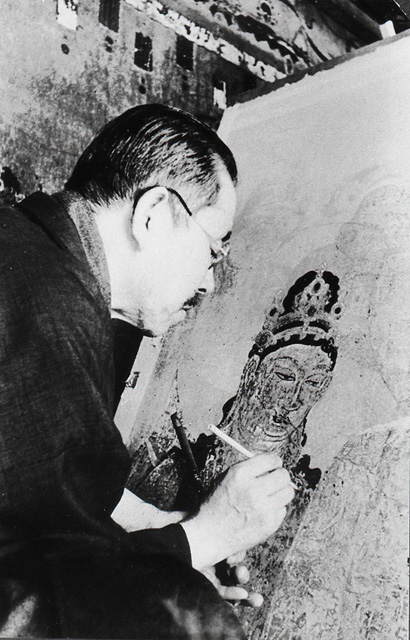
Arai Kampō reproducing a mural of Hōryū-ji
Collection of the Sakura City Museum (Arai Kampō Memorial Museum)
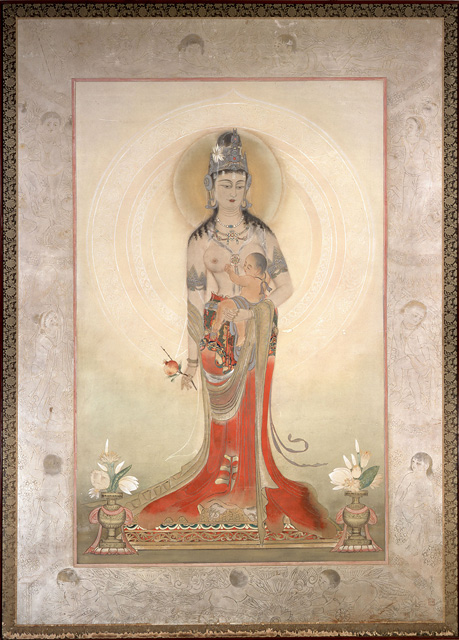
Hariti (Kishibo), exhibited at the Shin-teiten (New Imperial Art Academy Exhibition) in 1936
Collection of the Sakura City Museum (Arai Kampō Memorial Museum)
Timeline
| Year (Japanese Calendar) | Events |
|---|---|
| 1878 (Meiji 11) - 0 years old |
Born Kanjūrō on August 15 in Honmachi, Ujiie Town, Shioya District, Tochigi Prefecture, as the son of Arai Tōkichi and his wife Yote.
Tōkichi is a pictorial decorator for crests and lanterns, later transformed into painter with the art name Soun. |
| 1884 (Meiji 17) 6 years old |
Enrolled at Kaimeikan (present-day Ujiie Elementary School). |
| 1887 (Meiji 20) 9 years old |
Tōkichi adopts the art name Soun with aspirations to become a painter. |
| 1889 (Meiji 22) 11 years old |
Tokyo Fine Arts School opens.
Kokka-sha, the art magazine publisher is founded. |
| 1890 (Meiji 23) 12 years old |
Okakura Kakuzō (Tenshin) becomes the principal of Tokyo Fine Arts School. |
| 1891 (Meiji 24) 13 years old |
Soun wins a first prize at the painting exhibition of the Japan Art Association. |
| 1893 (Meiji 26) 15 years old |
Soun moves to Tokyo to pursue a career in painting in Ikenohata, Ueno, but abandons his dream due to the deterioration of his eyesight. |
| 1898 (Meiji 31) 20 years old |
In March, Okakura resigns as principal of Tokyo Fine Arts School due to troubles at the school.
On July 7, Japan Art Institute is established. |
| 1899 (Meiji 32) 21 years old |
Arai family relocates to Negishi, Shitaya, Tokyo.
In June, the family moves to Motokanasugi, Nippori, Toshima District. Studies under Mizuno Toshikata, along with fellow disciples such as Kaburaki Kiyokata, Ikeda Terukata, and Ōno Shizukata. |
| 1900 (Meiji 33) 22 years old |
Granted permission to use the character “kata,” part of his master's name Toshikata, thereafter uses the art name “Hirokata,” but in practice, commonly known as “Kampō.”
Imamura Shikō joins the painting group Shikō-kai, which is subsequently renamed Kōji-kai. |
| 1901 (Meiji 34) 23 years old |
In December, Okakura travels to India and meets Rabindranath Tagore.
Receives a second-class commendation for "Warmth" at the joint event of the 10th Japan Association for Painting Exhibition and the 5th Japan Art Institute Exhibition. Receives a second-class commendation for "Kojima Takanori" and "Children's Play" at the joint event of the 11th Japan Association for Painting Exhibition and the 6th Japan Art Institute Exhibition. |
| 1902 (Meiji 35) 24 years old |
Joins Kokka-sha, the art magazine publisher and works there until 1944.
Suffers from beriberi and recuperates at the residence of the Kuboi family, his relatives in his hometown. In November, Kampō marries Kuboi Chiyo (later renamed Hisae). Receives a second-class commendation for "Beauty under the Cherry Blossoms" at the joint event of the 12th Japan Association for Painting Exhibition and the 7th Japan Art Institute Exhibition. Receives a second-class commendation for "Fallen Samurai" at the joint event of the 13th Japan Association for Painting Exhibition and the 8th Japan Art Institute Exhibition. |
| 1903 (Meiji 36) 25 years old |
Yokoyama Taikan and Hishida Shunsō travel to India. |
| 1904 (Meiji 37) 26 years old |
In January, Kampō's eldest daughter, Kiyoko is born. |
| 1906 (Meiji 39) 28 years old |
In May and September, Kampō goes on a sketching trip to the Kansai region.
In November, Japan Art Institute relocates to Izura. Meets Hara Tomitarō (Sankei), the merchant from Yokohama on the occasion of a work for Kokka-sha. |
| 1907 (Meiji 40) 29 years old |
In March, Kampō goes on a sketching trip to the Kansai region.
The first Bunten (art exhibition sponsored by the Ministry of Education) is held, with Okakura Kakuzō, Yokoyama Taikan, and Shimomura Kanzan serving as judges. "Under the Bodhi Tree" is accepted for this inaugural Bunten Exhibition. During that time, he comes under the patronage of Hara Sankei and receives a monthly stipend of 15 yen. Moves to Nakanegishi, Shitaya Ward. |
| 1908 (Meiji 41) 30 years old |
In April, Mizuno Toshikata passes away.
Wins a third-class award for "Off to Battle" at the 2nd Bunten. |
| 1909 (Meiji 42) 31 years old |
From March to April, Kampō and his father go on a sketching trip to the Kansai, Shikoku, and Chūgoku regions.
A sketching study session is held at Ikeda Terukata's residence. Kampō joins the Tatsumi Gakai (Tatsumi Art Society). In April, Kampō's second daughter, Yoshie is born. Receives a third-class award for “Archery Game” at the 3rd Bunten. |
| 1910 (Meiji 43) 32 years old |
Travels to the hot springs at Shiobara and Kawaji with Ōno Shizukata and others.
Receives a commendation for "Carriage Contest" at the 4th Bunten. |
| 1911 (Meiji 44) 33 years old |
In June, Kampō's son, Hideo is born.
Joins the art group Kōji-kai. Receives a commendation for "Listening to the Dharma in a Bamboo Grove" at the 5th Bunten. |
1912 (Meiji 45, Taisho 1) |
Rejected for the entry of “Imperial Departure for Battle” in the 6th Bunten Exhibition.
Okakura travels to India again. In December, Kampō's third daughter, Yaeko is born. |
| 1913 (Taisho 2) 35 years old |
On August 15, Kampō's father, Tokichi passes away.
"Amida" is exhibited at the 7th Bunten Exhibition.
On September 2, Okakura Kakuzō passes away.
In November, Rabindranath Tagore becomes the first Nobel Laureate in Literature from Asia. Exhibits "Offering of Milk Porridge" at the 19th Kōji-kai Exhibition. |
| 1914 (Taisho 3) 36 years old |
In February, Imamura Shikō travels to India.
In August, Yokoyama Taikan was dismissed as a judge for the Bunten. Shimomura Kanzan resigned in solidarity. In September, the Japan Art Institute is revived by the core members: Yokoyama Taikan, Shimomura Kanzan, Kimura Buzan, Yasuda Yukihiko, Imamura Shikō, Kosugi Misei, Tatsuzawa Enjirō, Sasagawa Rinpū, and Saitō Ryūzō. Kampō also joins as an inyū (associate member). "Autumn Dusk" is accepted at the first Revival Inten (Revived Japan Art Institute Exibhition). |
| 1915 (Taisho 4) 37 years old |
In March, the Japan Art Institute begins holding its Study Exhibition, where Kampō also exhibits his works.
“Offering of Milk Porridge,” the highly acclaimed work for the 2nd Revival Inten enables Kampō to be recommended for dōjin (full membership). Moves to Kaminegishi, Shitaya Ward. In April, Kampō's fourth daughter, Kunie is born. "Ippen Shōnin" was exhibited at the 1st Japan Art Institute Study Exhibition. |
| 1916 (Taisho 5) 38 years old |
From May 29 to September 2, Rabindranath Tagore's visit to Japan attracts much attention, along with the occasions of his lectures.
An exhibition of Indian paintings is held at the Japan Art Institute in the midst of the widespread “Tagore boom.” Kampō is invited by Tagore to serve as an instructor of painting at the schools founded by him in Jorasanko and Santiniketan. In November, Kampō departs from Kobe Port for India with Katayama Nampū. In December, they arrive in Calcutta (present-day Kolkata). Kampō stays at the Tagore residence while Nampū stays at the Calcutta branch of Mitsui & Co. Exhibits "Lady Maya" at the 2nd Japan Art Institute Study Exhibition. |
| 1917 (Taisho 6) 39 years old |
From February 3 to 9, Tagore visits Japan on his way back from the United States.
While teaching painting at Santiniketan, Kampō undertakes a Buddhist pilgrimage with Oka Kyōsui, the Nichiren-sect priest from October 8 to November 27, departing from Calcutta and traveling through Madras, Ceylon, Madurai, Bangalore, Nashik, and Ellora before returning to Calcutta. In December, at the request of Taki Seiichi of Kokka-sha, Kampō begins reproducing the Ajanta murals, with Sawamura Sentarō as supervisor and Asai Kanpa as assistant. |
| 1918 (Taisho 7) 40 years old |
On March 2, Kampō completes the reproduction of the Ajanta murals.
In March, Kampō holds an exhibition of the Ajanta mural reproductions at the Japanese Club in Bombay (present-day Mumbai). From March 8 to April 2, Kampō leaves Bombay and travels via Sanchi to the Gandhara region, visiting Lahore, Rawalpindi, Peshawar, and Taxila. He then moves on to Delhi, Agra, Kushinagar, Sarnath, and Bodh Gaya before returning to Calcutta. On May 8, Tagore presents Kampō with a farewell poem upon his return to Japan. On May 11, Kampō departs from India and arrives back in Japan on May 31. In September, Kampō exhibits “Birth of the Buddha” at the 5th Revival Inten Exhibition. In Kampō's hometown, Ōhashi Ichirōemon and others organize the Kampō-kai (Kampō Association). Exhibits "White Cow" and "Benzaiten" at the 2nd Japa Art Institute Dōjin (Full members') Exhibition. Exhibits "Maya" and "Celestial Beings" at the Japan Art Institute New Works Exhibition. |
| 1919 (Taisho 8) 41 years old |
Exhibits “Siva from the Snowy Mountains” and “Early Summer Breeze” at the 6th Revival Inten Exhibition. Kampō's distinctive color schemes and subjects attract considerable attention.
In March, Kampō's fifth daughter, Reiko is born. Exhibits “The Deep Slumber of a Court Lady” and “Milk Spring” at the 3rd Japan Art Institute Dōjin Exhibition. |
| 1920 (Taisho 9) 42 years old |
In April, a group of dōjin (full members) of the Japan Art Institute, including Kampō, go on a trip to the Setouchi region.
In May, the first Kampō-kai Exhibition is held at the Nihonbashi Club. Kampō also exhibits “The Sacred Dream of Lady Maya” at the 7th Revival Inten Exhibition. In July, Kampō-kai Gashū (Art Collection of Kampō-Association) is published. Exhibits "Kisshōten" at the Japan Art Institute New Works Exhibition. |
| 1921 (Taisho 10) 43 years old |
The Japan Art Institute holds exhibitions in the United States, which travels to Boston, Cleveland, Pennsylvania, Washington, New York, and San Francisco.
Kampō exhibits “Myōonten” and “Dawn” for this occasion.
Moves to Hatsudai, Yoyogi. In January, Kampō's sixth daughter, Teruko is born. Exhibits "Halo" at the 8th Revival Inten Exhibition. |
| 1922 (Taisho 11) 44 years old |
The Japan Art Institute’s American Exhibition is held again in San Francisco, continuing from the previous year.
The Japan Art Institute Exhibition is held in Paris. Exhibits “The Land of Bliss” at the 9th Revival Inten Exhibition. Exhibits "Marishiten" and “Crane” at the 8th Japan Art Institute Trial Works Exhibition. |
| 1923 (Taisho 12) 45 years old |
The Great Kant Earthquake resulted in the loss of Kampō's reproductions of the Ajanta murals in the ensuing fires.
In July, Kampō’s seventh daughter Hiroko is born. Exhibits “Nirvana” at the 10th Revival Inten Exhibition. |
| 1924 (Taisho 13) 46 years old |
In June, Rabindranath Tagore returns to Japan together with the Indian painter Nandalal Bose.
Exhibits "Taima" at the 11th Revival Inten Exhibition. |
| 1925 (Taisho 14) 47 years old |
In April, Kampō and Nakamura Gakuryō travel through Korea, Manchuria, and China for about two months.
In October, Kampō travels to Taiwan on commission to depict Taiwanese customs as part of a picture scroll of Japanese customs created in celebration of Taishō Imperial Silver Wedding Anniversary. In July, Kampō presents a work at a study meeting of the Painting Division of Japan Art Institute, where the assigned theme is “Pigeons.” In September, Kampō joins an excursion to Izura arranged by the Japan Art Institute. In December, Kampō presents a work at a study meeting of the Painting Division of Japan Art Institute, on the assigned theme “Late Autumn.” Exhibits "Human Emotions" at the 12th Revival Inten Exhibition. |
| 1926 (Taisho 15, Showa 1) 48 years old |
In April, the Kampō-kai publishes a collection of forty-four of Kampō’s works under the title Kampō gashū (Kampō's Paintig Collection).
From April to August, Kampō travels around the world with his hometown friend Takizawa Naoshichi, meeting Tagore twice, once in Rome and once in Geneva. In October, Kampō joins an excursion to the Nikkō Yumoto area arranged by the Japan Art Institute. |
| 1927 (Showa 2) 49 years old |
In January, Kampō presents a work at a study meeting of the Painting Division of Japan Art Institute, on the assigned theme "magnanimity."
Commissioned to produce a work for the mural series to commemorate Emperor Meiji at the Seitoku Memorial Picture Gallery in Meiji Jingū Gaien (The outer precinct of Meiji Shrine). His assigned subject is the “Imperial Visit to the Tomioka Silk Mill.” Joins an excursion to Itako arranged by the Japan Art Institute. Exhibits “Xuanzang and Emperor Taizong” at the 14th Revival Inten Exhibition. Exhibits “Snow” and “Ice” (Two Themes from Siberia) at the 12th Japan Art Institute Trial Works Exhibition. |
| 1928 (Showa 3) 50 years old |
Exhibits “Black Horse” at the 15th Revival Inten Exhibition. |
| 1929 (Showa 4) 51 years old |
In June, the Paris Exhibition of Japanese Art is held.
Engages for seventy days in the creation of the wall paintings for the administrative office of Nikkō Tōshōgū Shrine, along with Nakamura Gakuryō, Katayama Nampū, and others. In March, Tagore visited Japan on his way to Canada, and again in May on his way back. During his stay in Japan, Tagore gave Kampō a portion of the manuscript for Philosophy of Leisure. Exhibits “Kitten” and “Clear Stream” at the 14th Japan Art Institute Trial Works Exhibition. Exhibits "Dondoyaki" and “The Star of Longevity” at the 16th Revival Inten Exhibition. |
| 1930 (Showa 5) 52 years old |
In April, Kampō exhibits "Cat" at the Japanese Art Exhibition in Rome.
In April, the Japan Art Institute Dōjin Exhibition is held in Czechoslovakia. Kampō exhibits "Crab" and "Plum Blossoms and Sparrow" for this occasion. Organizes the Kegon-sha, the art group, together with fellow Tochigi-born painters, Kobori Tomoto and Kosugi Hōan. Exhibits “Samantabhadra" at the 17th Revival Inten Exhibition. |
| 1931 (Showa 6) 53 years old |
In January, the Japanese-style Painting Exhibition is held in Berlin.
In May, the Japanese Art Exhibition is held in Budapest. From November, Kampō exhibits "Squirrel" in the Japanese Painting Exhibitions in the United States, which travels to Toledo, New York, Boston, Baltimore, Milwaukee, Cincinnati, St. Louis, and Los Angeles. In November, under the arrangement of Hara Sankei, Kampō visits the Tomioka Silk Mill in Gunma to prepare for his mural painting for the Seitoku Memorial Picture Gallery. Yokoyama Taikan becomes a member of the Imperial Art Academy. Exhibits "Dragon and Tiger" at the 18th Revival Inten Exhibition. |
| 1932 (Showa 7) 54 years old |
Due to an eye disease caused by high blood pressure, Kampō has to suspend his work. |
| 1933 (Showa 8) 55 years old |
In March, Kampō paints a mural for the Shimotsuke Savings Bank in Utsunomiya.
In May, Kampō's mural painting for the Seitoku Memorial Picture Gallery is completed. The preliminary sketch for "Imperial Visit to the Tomioka Silk Mill" is donated to his alma mater, Ujiie Elementary School. With his pupils, Kampō establishes an art school named Kōzen-sha. Set up a studio in Karuizawa, and from this time onward, produces his annual submissions to the Inten Exhibition there. Exhibits “The Sea” at the 1st Kōzen-sha Exhibition. Exhibits “Primitiveness" at the 20th Revival Inten Exhibition. |
| 1934 (Showa 9) 56 years old |
Paints "Birth of the Buddha" at the request of Hosokawa Rikizō, the president of Meguro Gajoen. Starting from this commission, Kampō spends the next three years producing ceiling paintings for the venue, during which a special room known as the “Kampō no Ma” (Room of Kampō) is created (which is no longer extant).
In February, the Japan Art Institute Dōjin Exhibition is held. Exhibits "Pure Pond" at the 18th Japan Art Institute Trial Works Exhibition. Exhibits “Birth of the Buddha” and "Temple of the Moon" at the 2nd Kōzen-sha Exhibition. |
| 1935 (Showa 10) 57 years old |
Draws the illustrations for Osaragi Jirō’s "Dainankō" serialized in the Asahi Shimbun.
Matsuda Genji, Minister of Education makes a proposal to establish a newly unified exhibition that includes both governmental and non-governmental, by merging the Teiten (Imperial Art Academy Exhibition) and the Inten into Shin-teiten (New Imperial Art Academy Exhibition). In May, Kampō is designated by the Ministry of Education as one of twenty-six artists who are granted a status in the Imperial Art Academy to be exempted from jury screening. Exhibits “Acala” at the 19th Japan Art Institute Trial Works Exhibition. Exhibits "Kataokayama" and "Beautiful Day" at the 3rd Kōzen-sha Exhibition. |
| 1936 (Showa 11) 58 years old |
Exhibits "Hariti" at the 1st Shin-teiten Exhibition.
In June, Kampō travels to Korea with his wife. In September, Kampō hinoene butsuga-shū (Kampō's Buddhist Painting Collection, Hinoene Edhition) is published. Exhibits "Limpid Water Reflecting Great Compassion" at the 23rd Revival Inten Exhibition. |
| 1937 (Showa 12) 59 years old |
From September, Kampō draws the illustrations for Hirano Tomoo’s "Rennyo Shōnin" serialized in the Nagoya Shimbun.
Exhibits “Maple-Viewing Scroll,” depicting the miraculous efficacy of Kitamuki Kannon in Shinshū, at the 24th Revival Inten Exhibition, and dedicates both the finished work and its preliminary sketch to Jōraku-ji Temple, the head temple of Kitamuki Kannon. Yokoyama Taikan and Takeuchi Seihō receive the inaugural Order of Culture. Exhibits “Acala” at the 5th Kōzen-sha Exhibition. |
| 1938 (Showa 13) 60 years old |
Exhibits “Peace Between Heaven and Earth” at the 25th Revival Inten Exhibition, and “Fish-Basket Kannon” at the 6th Kōzen-sha Exhibition. |
| 1939 (Showa 14) 61 years old |
The Research Committee for the Preservation of the Murals at Hōryū-ji is established
Kampō and three others are selected as chief artists for the restoration and reproduction of the mural paintings in the Kondō (Golden Hall) of Hōryū-ji. Hara Sankei, Kampō's patron passes away. September marks the outbreak of World War II. Draws the illustrations for Yoshikawa Eiji's "Minamoto no Yoritomo" serialized in the Asahi Shimbun. Exhibits "Kannon Mari" at the 26th Revival Inten Exhibition. |
| 1940 (Showa 15) 62 years old |
In September, Kampō begins reproducing the mural paintings in the Kondō (Golden Hall) of Hōryū-ji.
Publishes Kampō butsuga-shū (Kampō's Buddhist Painting Collection) in the same month. In October, Kampō holds his first solo exhibition at Takashimaya in Tokyo. |
| 1941 (Showa 16) 63 years old |
On August 7, Tagore passes away.
From April 1 to June 10, Kampō works on the restoration and reproduction of the mural paintings in the Kondō (Golden Hall) of Hōryū-ji. In August, Kampō paints the ceiling panels at Taimadera Temple. From September 29 to December 2, Kampō again works on the restoration and reproduction of the Hōryū-ji Kondō murals. In December, Japan enters the Pacific War. Art magazines are consolidated. Exhibits "Marici" at the 28th Revival Inten Exhibition. |
| 1942 (Showa 17) 64 years old |
From March 27 to May 30, Kampō works on the restoration and reproduction of the mural paintings in the Kondō of Hōryū-ji.
In August, Kampō produces the preliminary sketches for the murals of Bentendō on Chikubushima in Lake Biwa. From September 23 to December 15, Kampō again works on the restoration and reproduction of the Hōryū-ji Kondō murals. In October, Kampō commences to work on the murals for Bentendō on Chikubushima. In December, Kampō's mother, Yote passes away. |
| 1943 (Showa 18) 65 years old |
From March 18 to July 28, Kampō works on the restoration and reproduction of the mural paintings in the Kondō of Hōryū-ji.
In June, Kampō visits Bentendō on Chikubushima. Draws the illustrations for Mori Senzō’s ”The Loyalist Story of Shōheikō" serialized in the evening edition of the Asahi Shimbun. From September 27 to December 10, Kampō again works on the restoration and reproduction of the Hōryū-ji Kondō murals. In September, Amida-in zakki (Miscellany from Amida-in) is published. Draws the illustrations for Osaragi Jirō’s "Minamoto no Sanetomo" serialized in Fujin Sekai (The Women’s World). In November, Kampō goes on a sketching trip to Ōya Kannon. |
| 1944 (Showa 19) 66 years old |
From April 1 to July 28, Kampō works on the restoration and reproduction of the mural paintings in the Kondō of Hōryū-ji.
From October 1 to December 15, Kampō again works on the restoration and reproduction of the mural paintings in the Kondō of Hōryū-ji. In November, Kampō visits Bentendō on Chikubushima to finish the mural painting. Under the deteriorating war situation, all public submissions to art exhibitions, including those with the Inten, are prohibited. Kampō and his family evacuate from Tokyo to his hometown, Ujiie-machi. |
| 1945 (Showa 20) 67 years old |
In December, Kampō produces "Chihaya Castle" as a donation to the Kasumigaura Naval Air Corps.
In April, Kampō attends a school reunion in his hometown of Ujiie. On the 16th of the same month, he departs from Ujiie for Hōryū-ji. While traveling to Nara via the Hokuriku Line to avoid the air raids, Kampō suffers a sudden stroke and passes away on the train at Kōriyama Station in Fukushima Prefecture. Kampō's tombstone is installed at Kōmyō-ji Temple in Ujiie-machi. His posthumous Buddhist name is "Hōryūin Saiun Kampō Seikoji," which is engraved on the tombstone in Nakamura Gakuryō's handwriting. August marks the end of the war. |
Compiled by Sakura City Museum Arai Kampō Memorial Museum