
“Arai Kampō’s Journey to India and the Background of Indo Nisshi (India Diary)”
Introduction
The beginning of Kampō’s journey to India was hinted by a single Sanskrit verse:
“Lead me from darkness to light”
(Tamaso Ma Jyotir Gamaya)
This is a hymn of prayer from the Upanishads which was spontaneously uttered by an Indian poet upon seeing a work of Japanese-style painting. The poet was Rabindranath Tagore. The painting work was Yoroboshi (The Weakling, 1915) which depicted a blind youth wandering in search of his parents. One evening, he begins to meditate beside a blooming plum tree, envisioning the Sukhavati Pure Land (the Land of Bliss in the West) while facing the sunset, which he is unable to see. It was painted by Shimomura Kanzan, who was born into a family of Noh actors, at Sankeien Garden in Yokohama. Moved by this painting, Tagore wished to own it. Since the original could not be offered, a reproduction was the only option. It was Arai Kampō who was asked to work on it. Seeing how Kampō worked everyday, Tagore conceived the idea of inviting a painter to teach Japanese-style painting to Indian artists. He made a formal request to the Japan Art Institute to send a painter to India as an instructor. At the time, Indian artists were engaged in the creation of indigenous modern painting, rooted in the traditions of Indian miniatures, notably the Mughal and Rajput styles. The Japan Art Institute and Hara Sankei, the owner of Sankeien Garden, recommended Kampō as a painting instructor for Indian artists.
Kampō completed the reproduction of Yoroboshi after spending about two months at Sankeien Garden and took it with him to India. The work is now preserved at Visva-Bharati University in Santiniketan.
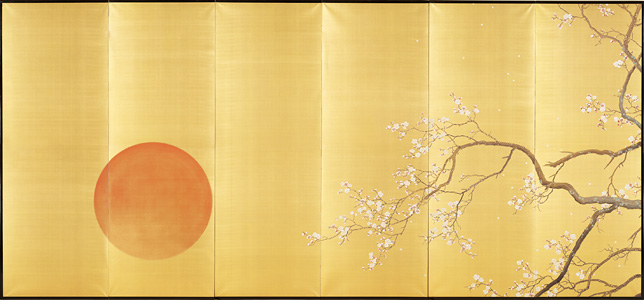
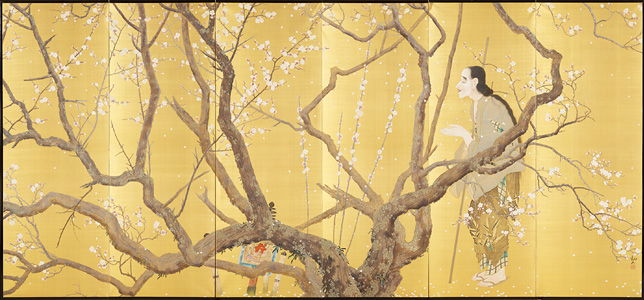
Yoroboshi, Shimomura Kanzan, 1915, Color and gold leaf on silk, 186.4×406, Tokyo National Museum, Japan
Source: ColBase, Integrated Collection Database of the National Institutes for Cultural Heritage, Japan (https://colbase.nich.go.jp)
Tagore’s Letter
Tagore wrote a following letter to his eldest son. “In two months, a prominent Japanese artist Arai will come to Calcutta. Get prepared for his stay at the Bichitra Studio for at least six months. Make arrangements for him to have a room at the end of the new building and dine with him. Let Abanindranath know about it… If Nandalal and others could learn from Mr. Arai how to paint large works using Japanese brushes, our art will make a great advance. Mr. Arai says, ‘I have vowed to paint Indian themes for life.’ You can help him fulfill his wish by living together. If you come to like Mr. Arai very much, he may stay for a year or two. Then all the young artists will become proficient in brush work…” Tagore also noted Kampō was making reproductions of large paintings by Kanzan and Taikan, and expressed his concerns about proper storage and care of the fragile folding screens. (Azuma Kazuo, Tagōru no sekai (The World of Tagore), Daisan bunmei-sha, 2017, pp. 307-308.)
Kampō’s Journeys
During the Meiji and Taishō periods, artists traveled extensively. After joining the Japan Art Institute, Arai Kampō traveled with fellow members, including Yokoyama Taikan, across the Seto Inland Sea. He also traveled to Toyama with Kosugi Hōan to see the Owara kaze no bon festival, a folk music and dance festival in early September. Kampō ventured abroad three times. His first overseas trip was a nearly two-year stay in India. In later years, he circled the globe with the banker Takizawa Naoshichi, even meeting Tagore again by chance in Italy. He also traveled with Nakamura Gakuryō through Korea, Manchuria and Taiwan, and returned to Korea with his wife afterwards.
November 13, 1917 marked the start of Kamp's journey to India. He embarked on a 568-day journey after receiving farewells from more than a hundred people, including Taikan at Tokyo Station and Kanzan at Yokohama Station. Kampō kept a diary throughout his journey without missing a single day, and drew nearly 900 sketches, gaining vivid insights into the customs and landscapes of India over a century ago.
Supplementary Materials Included:
- 1. Original manuscript of the India Diary
- 2. Map of Kampō’s journey in India
- 3. Tagore’s handwritten poems
- 4. Reproductions of the Ajanta cave murals
- 5. Kampō’s photographs in India
- 6. Correspondence with Bengali artists (postcards, etc.)
- 7. Essay by Kampō: Impressions of India
- 8. Essay by Kampō: Miscellany from Amida-in
- 9. Genealogy of the Tagore family
- 10. Two rare photographs of Tagore and Arai Kampō together
Conclusion
While a partial excerpt from the India Diary was published by Chūōkōron-sha, this project completes the full transcription of the Diary and collation of Kampō’s sketches. To me, the whole process of working on this project, appreciating his words and drawings day by day, was like a heart-pounding journey with Kampō, my grandfather. Despite not knowing English or any local Indian languages initially, Kampō managed to communicate and connect with the locals, including the Tagores, the artists who he taught painting to, and people whom he met during the trip. The Diary implies he communicated with them in English. It is impressive how well he was able to understand and be understood.
On his own birthday, Tagore presented Kampō with a poem written in calligraphy before Kampō’s departure from India. It is now preserved at the Arai Kampō Memorial Museum in Sakura City, Tochigi Prefecture.
During his stay in India, Kampō was asked by his former superior, Taki Seiichi from Kokka-sha to replicate the Ajanta cave murals. Over the course of three months, he made reproductions of the key works. Unfortunately, the majority of the works that had been preserved at Tokyo University were destroyed in the 1923 Great Kanto Earthquake, though about a dozen pieces remain and are included in this digital archive.
Kampō was engaged in the reproduction project of the Hōryū-ji murals that was launched during World War II. However, he passed away suddenly while en route to Nara. Though Kampō’s portion was nearly finished, the mural project was halted due to the worsening war. Ironically, the Hōryūji murals were also destroyed by fire in 1949.
Inoue Yasushi, the writer, quoted a phrase used by Kampō, “All living things perish eventually.” It was most likely what he thought about the impermanence of things after witnessing the loss of his Ajanta works, which were meant to preserve the original image before it fell into ruin.
Yet, what remained was his intangible friendship with India. This bond is backed up by postcards and letters from friends such as Abanindranath Tagore, Gaganendranath, Surendranath, Nandalal Bose, Asit Haldar, and Mukul Dey. Kampō’s India Diary mentions many Bengalis, all of whom had a deep friendship with him. Kampō was fondly called “Kampō-san” by them, and he loved all of them equally. My late cousin, Arai Seiya, stated that while Okakura Tenshin, as a pioneer, laid the foundation for India-Japan artistic ties, and Taikan and Shunsō added to it, Kampō’s close personal interaction with Bengalis made those relations more fruitful.
This archive is a record of India-Japan cultural exchange in modern times. Special thanks go to many collaborators including:
- • Shida Yasuhiro (Tochigi Prefectural Museum of Fine Arts)
- • Ōki Reiko (Sakura City Museum)
- • Hida Kou (Horiuchi Color)
- • Oikawa Akio (Transcription and proofreading)
- • Okamoto Yoshiko (Institute of Asian Cultural Studies, International Christian University)
- • Prof. Togawa Masahiko (Tokyo University of Foreign Studies)
- • Takahara Masako, the author’s daughter, for her devoted support.