
Tagore’s handwritten poems
(Collection of Sakura City Museum – Arai Kampō Memorial Museum)
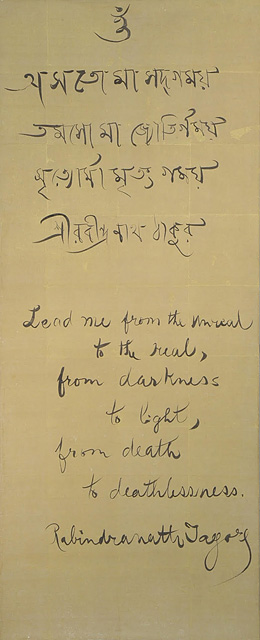
1. Calligraphy by Rabindranath Tagore
c. 1916 – c. 1929
Ink on silk, framed, 90.0 × 40.5 cm
Collection of Sakura City Museum (Arai Kampō Memorial Museum)
During his first visit to Japan, Tagore was deeply moved by the scenery and people.
He was also impressed by the profound spirituality and high technical artistry of Nihonga (Japanese-style painting) especially when he saw Yoroboshi by Shimomura Kanzan, which had been exhibited at the 2nd Revival Inten Exhibition in 1915.
This calligraphy is believed to have been in the possession of Kanzan. The box bears Kanzan’s inscription, “Gurudev Tagore.” It is presumed that Tagore gifted Kanzan with this piece when they met.
It subsequently came into the possession of Ogura Yuki, a Nihonga painter and fellow member of the Japan Art Institute (Nihon bijutsu-in). She treasured this calligraphy displaying it in her home for many years.
The English passage reads:
Lead me from the unreal
to the real,
from darkness
to light,
from death
to deathlessness
—– Rabindranath Tagore
This quote reveals Tagore’s philosophy on rebirth and being.
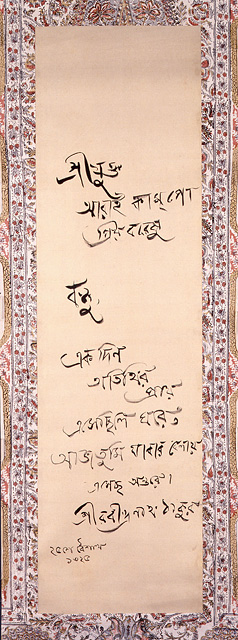
2. Poem by Rabindranath Tagore
1918
Ink on silk, hanging scroll, 130.5 × 37.0 cm
Collection of Sakura City Museum (Arai Kampō Memorial Museum)
Between 1916 and 1918, Arai Kampō spent time with the Tagore family in India, deepening both real artistic exchanges and personal bonds with them. This scroll was a gift from Rabindranath Tagore to Kampō as a token of farewell. It is a beautiful piece of calligraphy, written with Japanese brush and ink, featuring a poem by Tagore.
To Mr. Kampō Arai
My beloved friend,
One day you came to my room
As a guest —–
Today, at the time of parting,
You have come into the innermost depths of my heart
The 25th Boishakh, 1325 by the Bengali Calendar
Rabindranath Tagore
(Translated into Japanese by Azuma Kazuo)
Source: Indo wo egaita sakka tachi: Tagōru seitan 150-nen kinen (Artists Who Depicted India: The 150th Anniversary of Tagore’s Birth, the 79th Special Exhibition), Sakura City Museum, 2011, pp. 18-19.